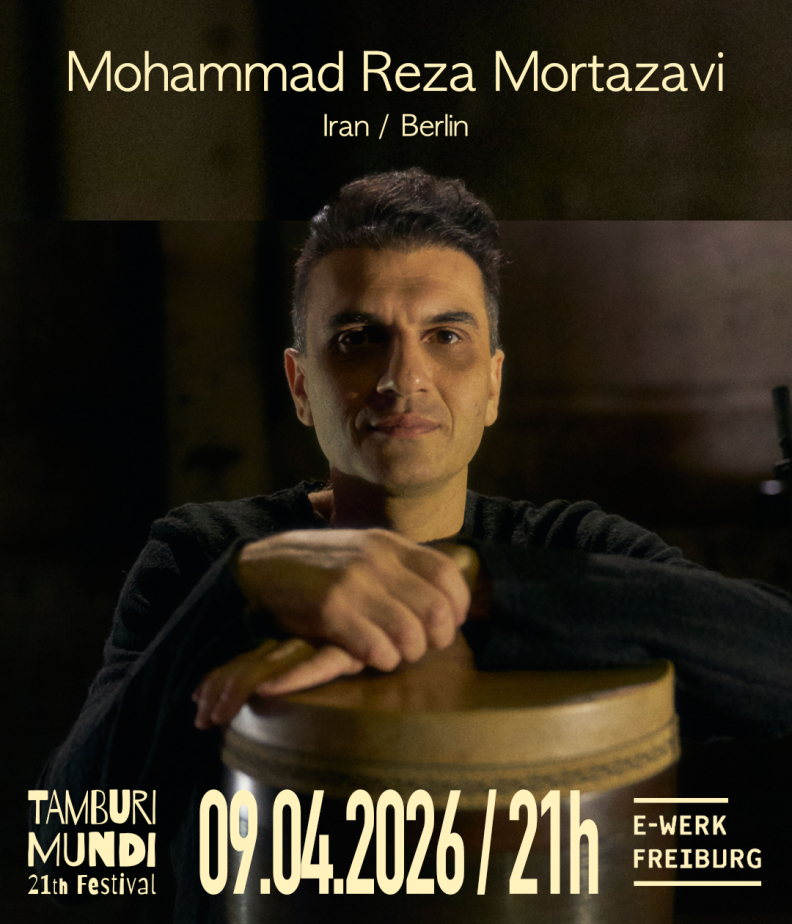
Recent Interview with Mohammad Reza Mortazavi (March 2026)
Mohammad, who were your teachers? To whom do you owe the most, both Iranian and international masters?
I started playing music at the age of six, and my main teacher was Hosseinpour Abutaleb, though I also took lessons from Majid Hesabi for a time. I received my first lessons using the standard, traditional method. But over the years—after more than 40 years of playing—I have come to realize that my true and eternal teacher is music itself—and always will be.
How does your style of playing the frame drum differ from the traditional approach? Can you give two or three examples of the innovations you’ve developed for the daf and tombak?
Just as with the tombak, my style of playing the daf has also evolved, because everything depends first and foremost on the player’s perspective and concentration. Since my focus and attention have been on music—and not just on the instrument—since childhood, I’ve had the opportunity to develop new techniques without any pressure. Music is limitless, yet it can integrate a limited instrument into its infinity. One example of this is the simultaneous playing of polyrhythmic and polyphonic structures on these instruments.
Do traditional rhythms still serve as the foundation for your pieces, or have you completely moved away from them?
Of course, I don’t adhere to the dogma that traditional rhythms must be played at all costs. But when necessary—and since these rhythms are deeply rooted within me—I draw on their beauty. It should be noted that what is new today, if it is truly new, may one day become tradition. When what we define as tradition is deeply anchored within us, it automatically changes its form. From this perspective, dogmatism regarding traditional rules has never been acceptable to me. From another perspective, music is love, and love knows no boundaries.
Have you developed the techniques or even the instruments yourself, or do you collaborate with a specific instrument maker?
Driven by a passion I’ve had since childhood and the connection between emotional perception and ecstasy, I’ve developed many techniques. This process arose quite naturally, on its own, and in a sense, as a matter of course. I don’t collaborate with a specific instrument maker. Many of the instruments I play are precious gifts from various instrument makers. Each instrument is—like every person—unique and provides me with different inspirations and ideas for composing and playing.
You left Iran because your style of playing broke the rules. What exactly was criticized about your playing?
Since my music took me beyond borders, on the one hand there was an audience that was very happy with the new style of playing that was just emerging and still evolving. On the other hand, I was simultaneously criticized by most traditional musicians and masters—to the point that I was denied permission to hold my concerts. This happened even though I had repeatedly won first prize at the national music festival in Iran. At the time, I was still a child or teenager. My current view of music no longer has anything to do with competition—for me, everything has become relative.
It is important to note that my main problem was not only the government, but also those very traditional masters who, on the one hand, claimed to champion enlightenment among young people, yet on the other hand hindered the growth and innovation of artists whose paths they did not approve of.
It is also important to mention that a cultural revolution had already taken place before the Islamic Revolution, one that was supported by these artists after the Islamic Revolution.
But society and history are awake.
Ultimately, I am very grateful for all that negative criticism and for being excluded during the time I lived in Iran, because that is precisely what led to my personal growth and the development of my own playing style—to the point where I left Iran both physically and emotionally.
What was the most important thing you learned after emigrating to the West that contributed to the development of your music?
That there are boundaries everywhere, and the realization that music is the most perfect language.
The track “Zendegi” on your new CD “Nexus” (“Connection”) is inspired by the “Woman. Life, Freedom” women’s movement. It has a rather dark atmosphere. Are you paying tribute to those courageous women with this piece?
I composed this piece at the time this movement emerged, but I didn’t release it until it aligned with the concept of the “Nexus” album.
Other pieces are also rather dark, such as “Cendres Volantes,” where sighing female voices can be heard in the background. What inspired this piece?
I composed this piece for a section of an opera in France, for a scene that was meant to transition from darkness into light.
The music is partly experimental and also electronically enhanced. How do you bring that to life on stage? Do you work with a loop station?
Currently, I compose my works using multitrack recording and a blend of acoustic and electronic elements. On stage, however, they are performed as solos, and all sounds and effects are generated directly through the instrument.
In “Dornâ,” you also incorporate sounds of the human voice, such as snoring and panting. What’s the story behind this piece?
In this piece, listening through headphones after the performance put me in a state of mystery and enigma. This bird conveys exactly that feeling to me.
Jordan Belson’s cover art looks very much like science fiction, which I think fits your music very well. Would you say you’re a “drum futurist”?
I’m happy that my style has had a profound influence on countless musicians around the world. Because love means giving.
Do you think that new prospects could open up for Iran following the intervention by the U.S. and Israel, and what might those look like?
I believe that, in accordance with the law of proportionality, Iranian society no longer fits its government, and I am very optimistic that the people will experience positive change. Iranian society has matured more than ever before, and a dictator no longer fits within it.